
Digital Signage Deployment: A Complete Guide to Installation and Management



- What Is Digital Signage?
- Why Digital Signage Deployment Matters
- Common Challenges in Digital Signage Deployment
- Planning Your Digital Signage Deployment
- Installation Day: Bringing Your Vision to Life
- Types of Digital Signage Installations
- Post-Installation: Maintenance and Management
- Why Partner with an Experienced Digital Signage Provider
- Conclusion
Digital signage has become one of the most effective ways for brands to communicate with their audiences in physical spaces. Whether installed in a retail store, a corporate lobby, a quick-service restaurant, or along a busy highway, digital displays offer dynamic, real-time communication that static signage simply cannot match.
However, a successful digital signage deployment involves far more than mounting a screen on a wall. It requires careful planning, the right technology choices, skilled installation, and ongoing management. This guide walks you through every stage of the process, from initial planning to post-installation care, so you can make the most of your digital signage investment.
What Is Digital Signage?
Digital signage refers to the use of electronic displays to broadcast information, advertisements, promotions, and other visual content. Unlike traditional printed signs, digital signage allows you to update content remotely, schedule different messages for different times of day, and deliver targeted communications based on location or audience.
Common applications include:
- Retail stores: Promotional displays, product information, and in-store navigation
- Quick-service restaurants: Digital menu boards that can be updated instantly
- Corporate environments: Internal communications, wayfinding, and visitor information
- Outdoor advertising: Digital billboards along highways and in high-traffic urban areas
- Educational institutions: Campus announcements, event information, and emergency alerts
Before diving into the technical aspects of installation, it is important to define what you want to achieve with digital signage. Whether the goal is to boost brand awareness, inform customers, or drive sales, a clear strategy ensures that every decision from hardware selection to content design supports your objectives.
Why Digital Signage Deployment Matters
A well-planned digital signage deployment delivers measurable benefits across multiple dimensions of your business:
- Dynamic content delivery: Update promotions, pricing, and messaging in real time without the cost and delay of reprinting physical materials
- Enhanced customer engagement: Vibrant, moving displays capture attention and hold it longer than static signage
- Operational flexibility: Schedule different content for different times of day, locations, or customer segments
- Cost efficiency over time: While the initial investment is higher than print, eliminating recurring printing and distribution costs makes digital signage more economical in the long run
- Centralised control: Manage content across multiple locations from a single platform, ensuring brand consistency
Common Challenges in Digital Signage Deployment
Despite its advantages, digital signage deployment comes with real challenges that brands need to anticipate and plan for. Understanding these upfront helps you avoid costly delays and ensure a smoother rollout.
1. Time-Consuming Planning and Approvals
The planning phase for digital signage can be extensive. Designing artwork, obtaining internal approvals, and finalising adaptations for different screen sizes and locations all take time. Without a structured workflow, these steps can delay your deployment by weeks or even months.
2. Selecting the Right Partners
Choosing the right digital signage installation companies is critical. Not all vendors have the same level of expertise in hardware installation, content management, or post-installation support. A partner mismatch can lead to quality issues, missed deadlines, and higher costs.
3. Multi-Vendor Coordination
When a deployment involves multiple vendors for hardware, software, content creation, and installation, coordination becomes a major challenge. Miscommunication between vendors can result in incompatible components, scheduling conflicts, and inconsistent quality across locations.
4. Communication Breakdowns
Managing reports, updates, and escalations across multiple stakeholders and single points of contact (SPoCs) often leads to miscommunication. Clear communication protocols and centralised project management are essential for keeping deployments on track.
5. Post-Installation Closure
After installation is complete, finalising vendor payments, verifying work quality, and closing out projects can be time-consuming. Authentication of work done across multiple sites and vendors requires robust documentation and verification processes.
Planning Your Digital Signage Deployment
A structured planning process is the foundation of every successful digital signage installation. Here is a step-by-step approach to get it right.
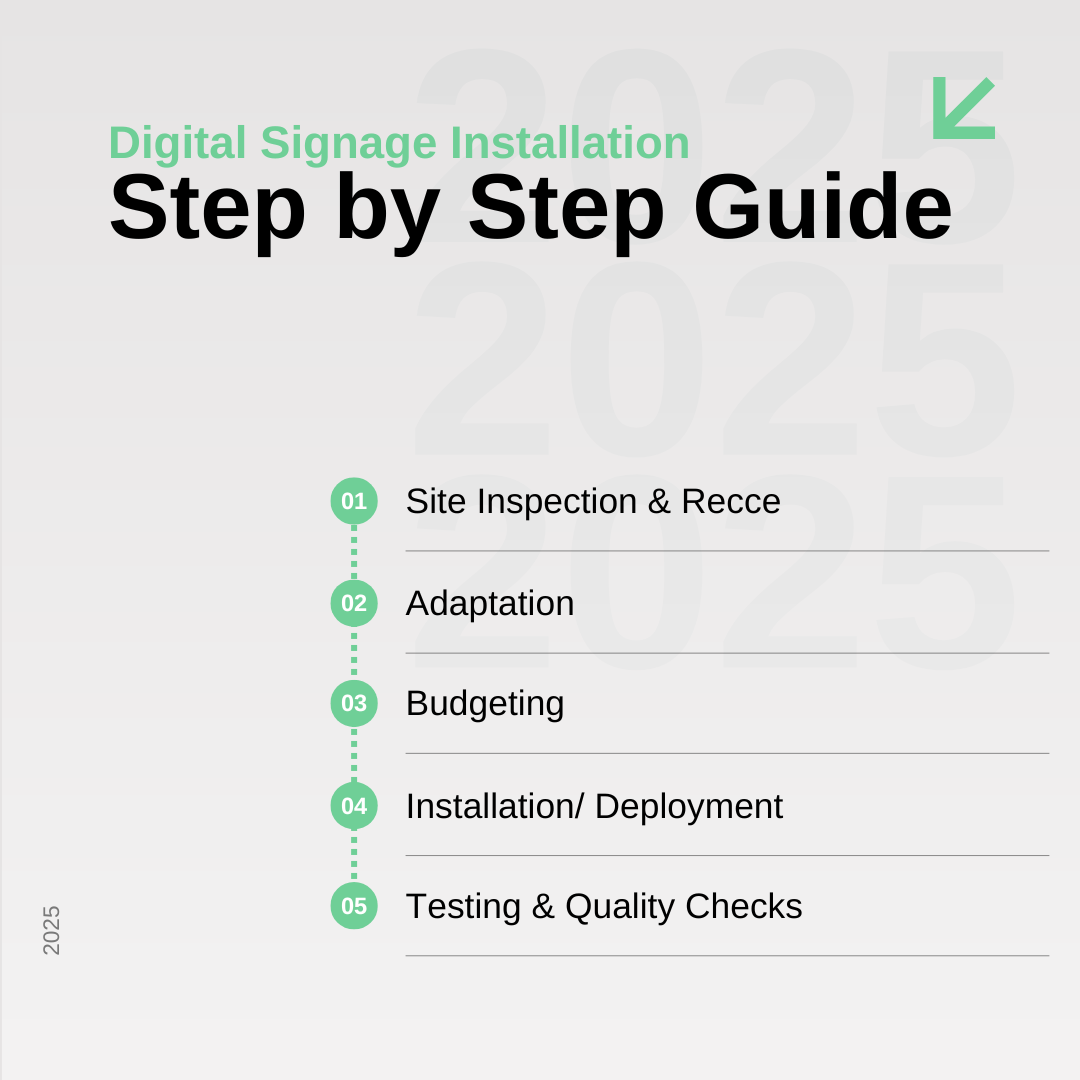
Step 1: Define Your Objectives and Audience
Start by clearly outlining what you want your digital signage to accomplish. Are you looking to drive in-store promotions? Provide wayfinding in a large facility? Replace static menu boards? Your objectives will determine everything from screen size and placement to content strategy and software requirements.
Equally important is understanding your audience. Consider their demographics, behaviour patterns, and what kind of content will resonate with them in the specific environment where the signage will be installed.
Step 2: Conduct a Site Survey (Recce)
Every successful digital signage installation begins with a thorough site survey. This involves visiting each location to assess:
- Optimal placement: Where will the display have the greatest visibility and impact?
- Power availability: Is there adequate electrical infrastructure to support the displays?
- Network connectivity: Will the displays need wired or wireless internet access for content updates?
- Structural support: Can the walls, poles, or mounting surfaces bear the weight of the hardware?
- Environmental factors: For outdoor installations, consider weather exposure, ambient light, and temperature extremes
Step 3: Choose the Right Hardware
Digital signage hardware varies significantly based on the use case. Key considerations include:
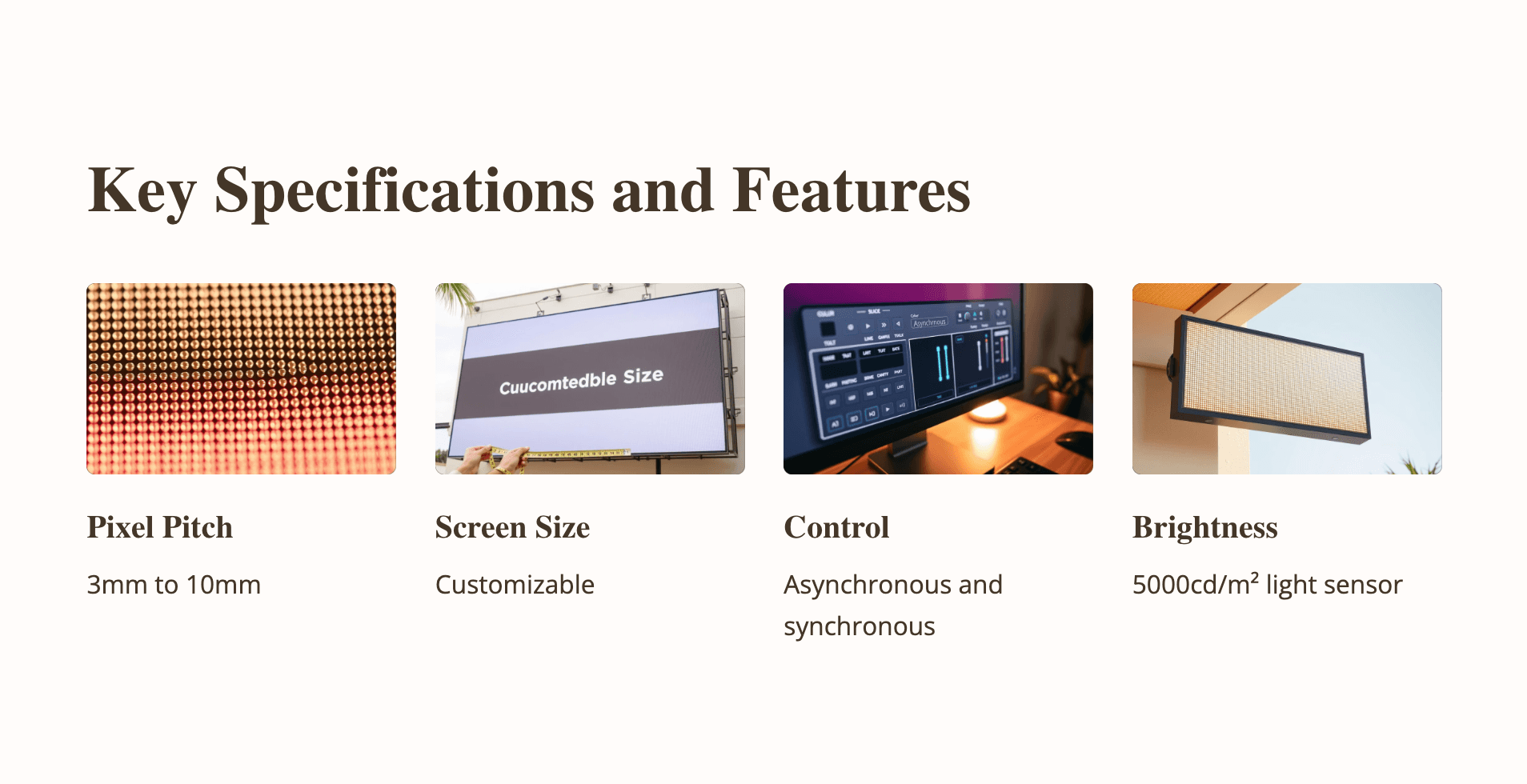
- Pixel pitch: Finer pixel pitch (e.g., 3mm) delivers higher resolution for close-viewing retail environments, while larger pitch (e.g., 10mm) works well for highway billboards viewed from a distance
- Brightness: Outdoor displays require high brightness levels to remain visible in direct sunlight
- Cabinet material: Outdoor installations need weatherproof enclosures, typically in iron or aluminium
- Control systems: Choose between asynchronous (offline/scheduled) and synchronous (real-time) content delivery based on your needs
Step 4: Customise Content for Each Location
Content should be tailored to each installation environment. A digital menu board installation in a restaurant requires a very different content approach than a digital billboard installation on a highway. Consider screen orientation (landscape vs. portrait), viewing distance, dwell time, and the specific messaging goals for each location.
Your content management system should make it straightforward to create, schedule, and update content across all locations without requiring on-site visits.
Step 5: Budget Realistically
A complete digital signage deployment budget should account for:
- Hardware costs: Displays, media players, mounts, and enclosures
- Installation labour: Professional installation by experienced teams
- Software licensing: Content management system subscriptions
- Content creation: Initial design and ongoing content production
- Maintenance: Regular inspections, cleaning, and repairs
- Connectivity: Internet service for remote content management
Installation Day: Bringing Your Vision to Life
The installation phase is where planning meets execution. A professional installation team should handle:
- Precise mounting: Whether wall-mounted, floor-standing, or pole-mounted, every display must be securely installed and properly aligned
- Electrical and network connections: Safe wiring, cable management, and network configuration
- Hardware testing: Verifying that all components are functioning correctly before going live
- Content deployment: Loading initial content and confirming that the content management system is properly connected
- Quality verification: Checking display quality, viewing angles, and ambient light performance
Types of Digital Signage Installations
The right installation style depends on your location, audience, and objectives. Here are the most common options:
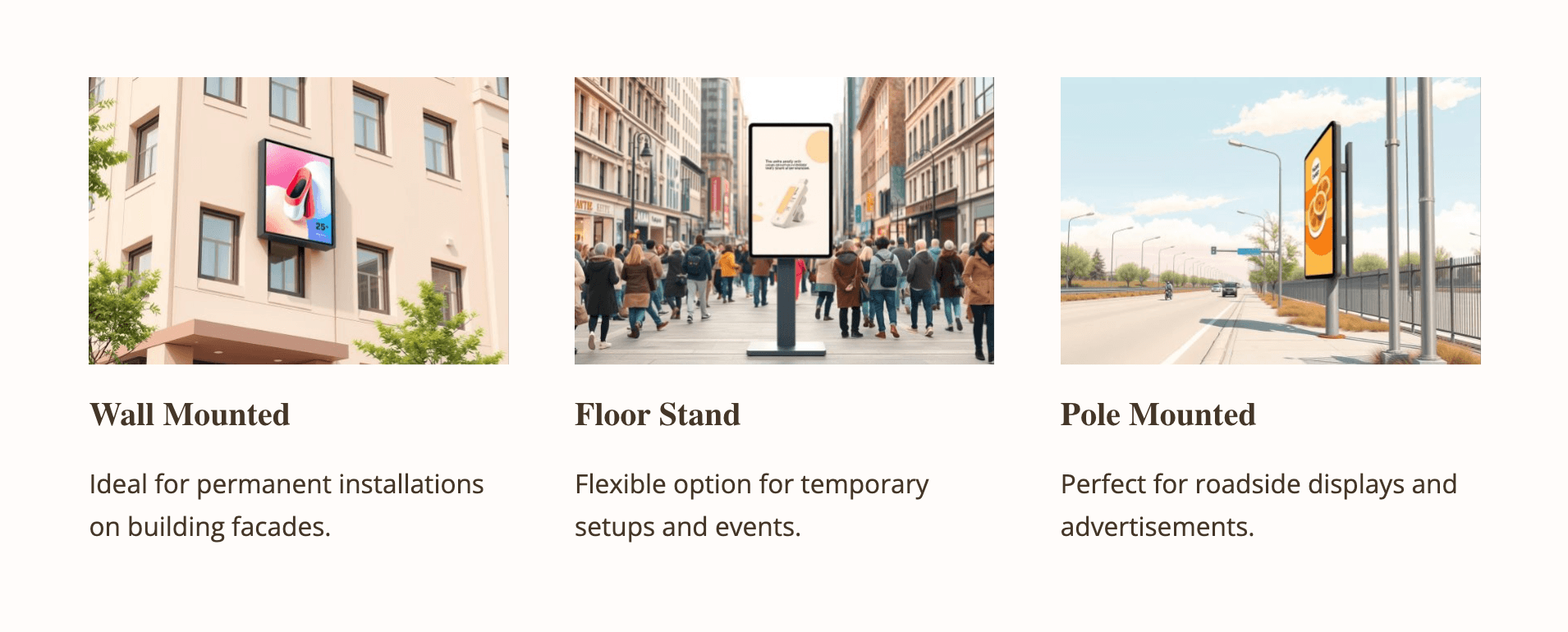
- Wall-mounted displays: Ideal for permanent installations in retail stores, corporate offices, and restaurants. These provide a clean, integrated look and are well-suited for digital menu boards and promotional displays
- Floor-standing kiosks: Offer flexibility for events, temporary promotions, and locations where wall mounting is not practical. They can be repositioned as needed
- Pole-mounted displays: Best for outdoor and high-traffic areas where elevated placement ensures maximum visibility. Common for outdoor digital signage along roads and in parking areas
- Ceiling-suspended displays: Used in large retail spaces, airports, and transit hubs where floor and wall space is limited
- Window-facing displays: High-brightness screens positioned behind glass to attract foot traffic from outside
Post-Installation: Maintenance and Management
A digital signage deployment does not end at installation. Ongoing maintenance and management are essential to protect your investment and keep your displays performing at their best.
- Regular inspections: Schedule routine checks to ensure displays are functioning properly, content is rendering correctly, and hardware is in good condition
- Software updates: Keep your content management system and media players updated with the latest firmware and security patches
- Content refreshes: Stale content diminishes the impact of your signage. Establish a content calendar to keep messaging fresh and relevant
- Performance monitoring: Track display uptime, content playback accuracy, and any hardware issues to address problems proactively
- Professional support: Partner with experienced signage maintenance providers who can handle repairs and replacements efficiently
Why Partner with an Experienced Digital Signage Provider
Managing a multi-location digital signage deployment in-house can be overwhelming. From coordinating site surveys and vendor management to ensuring consistent quality across every installation, the complexity increases with scale.
Channelplay offers end-to-end accountability for digital signage deployment projects. With operations spanning across multiple cities in India, Channelplay brings the capability to execute large-scale projects efficiently. The approach simplifies the process by serving as a single point of contact for planning, installation, campaign changeovers, and ongoing maintenance, ensuring consistency in pricing, quality, and service delivery across all locations.
Whether you need a handful of digital menu board installations for a restaurant chain or a nationwide rollout of digital signage across retail stores, working with an experienced partner reduces risk and accelerates time to deployment.
Conclusion
Digital signage deployment is a multi-stage process that requires careful planning, skilled execution, and ongoing management. From defining your objectives and conducting site surveys to selecting the right hardware and maintaining your displays post-installation, every step matters.
Key Takeaways:
- Start with clear objectives and a thorough understanding of your audience before selecting hardware or content
- Conduct detailed site surveys to avoid installation surprises related to power, connectivity, and structural support
- Choose an installation style (wall-mounted, floor-standing, pole-mounted) that matches your environment and audience behaviour
- Plan for ongoing maintenance, content refreshes, and software updates from the outset
- Consider partnering with an experienced provider for multi-location deployments to ensure consistency and accountability
With the right strategy and execution partner, digital signage can become a powerful, scalable communication tool that drives engagement, strengthens brand presence, and delivers measurable results across every location.
